

I failed my final exam in 12th grade.
A month before they kicked me out of high school, I had my final exam in English class. We had to write about what we'd learnt in the class, surrounding a theme of fear.
I had skipped the whole school week prior so I could go to an edtech conference in Orlando, so I winged it. I wrote about what I was genuinely passionate about. Over the years I had realized that time and time again, the school professing change and innovation, building up students with hope while controlling them with fear—only to reject it all when someone actually cared enough to make it happen.
That essay was more than just a grade. It was a wake-up call.
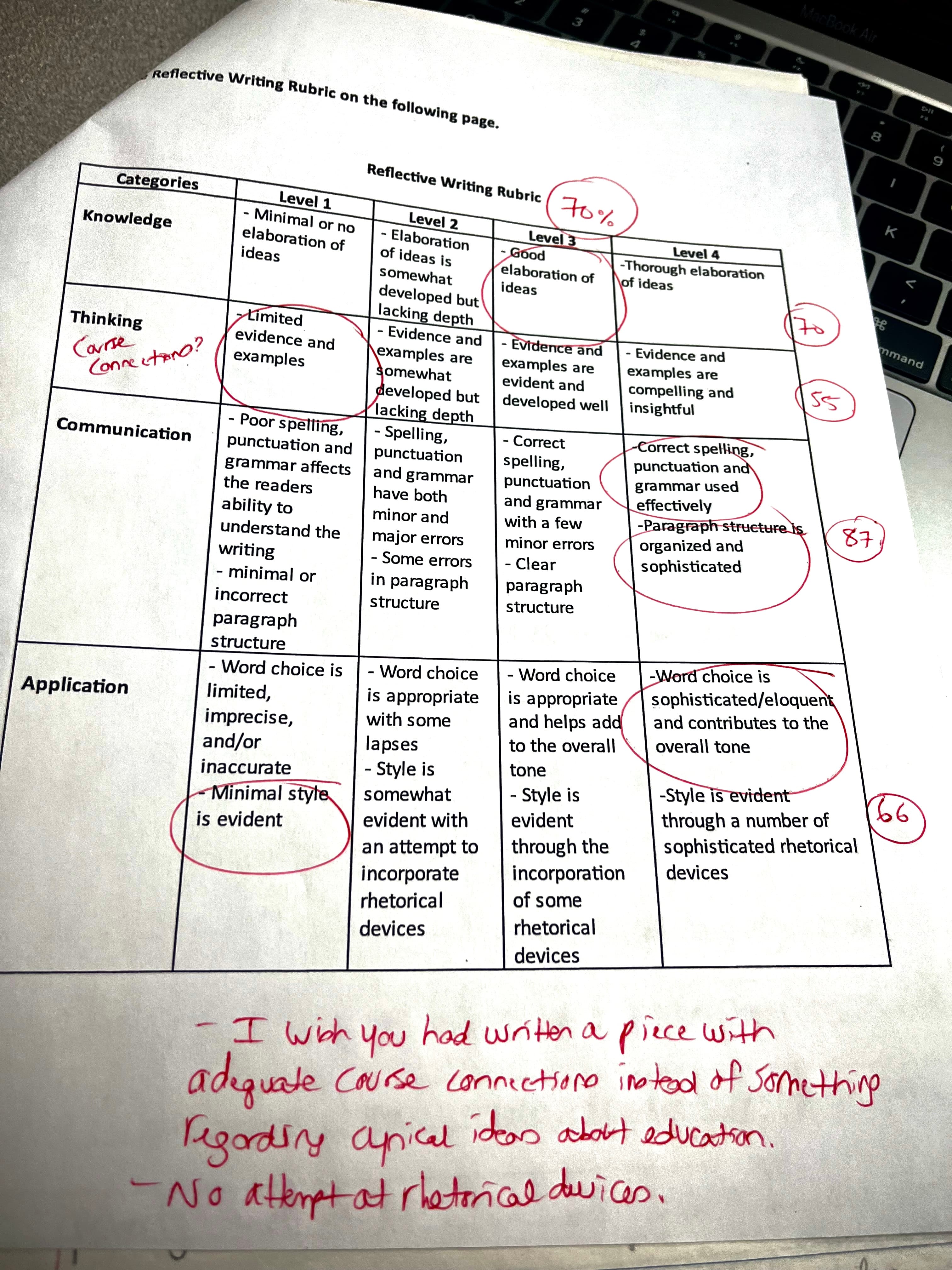
Here's what it said:
Fear is the fuel that can drive humans to do anything. It leads people to make completely irrational decisions, go against their values, and flock towards the general consensus.
Even when that consensus is illogical.
I particularly remember a moment at the beginning of the semester when about 95% of the class agreed that people should not focus on money or materialistic things.
Funny enough, we had just listened to a presentation on Marxist theory and everyone agreed that it sounded really nice but it didn't really work in practice.
That's when I realized that some behaviors and beliefs have been so embedded in our minds deep in the subconscious because of social conditioning that we're told things like money isn't important and it's become a taboo topic.
People frown upon those who strive for money and wealth as if it were a crime to have it. But everywhere I go, people seem to care a lot about money in the real world.
So the truth is, it's not that people actually believethat wealth isn't important.
But it was the wrong thing to say.
Social conditioning and reinforcement can be a good way to prevent misbehavior and enforce compliance.
Like let's say you're on the roads and you want to explore the speed at which you can go— that's probably not a good idea.
Negative reinforcement does a really good job at controlling populations and making sure that they don't explore new possibilities or creativity,
This is a really big problem in schools.
When it comes to educating the future generation of engineers, doctors, lawyers, artists, and even educators, negative reinforcement actually fosters not love for learning but apathy.
It continues that cycle where students are doing the
bare minimum to get by.
The reason students come to school today is not for their love of learning, but because of their fear of the punishment that would come if they didn't.
I know that for myself the only reason I'm writing this exam is out of the fear of not getting the credits to get my diploma and having downstream repercussions. And while I know now that I will be alright, it puts into question the entire system of contemporary education.
We're teaching the future workforce to do the bare minimum to avoid getting punished, rather than exploring frontiers never seen before by human civilization.
Now that is something we should be afraid of.
I had spent years trying to work with the system.
It was a pain point I witnessed first hand by both students and teachers, and I wanted to make the change because it was clearly a net positive. I went to 78 teachers at my school, including the one that inspired the idea in me when I saw her grading 60 papers in one evening, but all of them dismissed it. My district told me to submit a public tender. I was 16.
By 12th grade, I realized that I had to make it work, or submit to going to university or getting a job. And although it had been my dream to study at MIT, that dream had long passed, as I became disillusioned with the school system entirely.
I realized the incentives were misaligned.
At first I just thought they had the best of intentions, and simply didn't understand the benefit. But it wasn't that. It was that they didn't care enough about actually improving the system.
After all that—getting kicked out of high school, getting into YC at a 0.8% acceptance rate, getting covered on Forbes, a billboard in Times Square, and signing several independent schools and districts in the U.S.—my school still never acknowledged my work. Because to acknowledge it would be to admit that they were wrong.
To admit that their system was designed to make students do the bare minimum to avoid getting punished, rather than taking the catastrophic risk of possibly being wrong to have the chance of creating a better world. To acknowledge a straight-A student who decides to skip finals, drop all his courses and bet all his chips on his dream, is far too dangerous.
It would put into question why we sit students down for 12 years to drill into their minds not the fundamental concepts that they need, but to condition them to fear making mistakes. It would expose how they're conditioning students to do the opposite of what actually creates greatness, in favor of control.